The Game Boy Advance sports library splits cleanly in two, and knowing which half a cartridge belongs to tells you almost everything before you load it.
On one side are games designed for the hardware. Vicarious Visions built a custom isometric 3D engine so Tony Hawk could exist on a 240x160 screen. Camelot Software Planning took golf and tennis and wrapped them in role-playing games with experience points and a story. These are original designs that happen to be about sport.
On the other side are annual licensed releases — Madden, FIFA, NBA, MLB — handed to small contract studios and shipped alongside the console versions. A few of those are competent. Most are not, and the gap is not subtle: the worst game named on this page scores 37 out of 100, and the best scores 95.
Below are the ten Game Boy Advance sports games worth your time, ranked, with what each one actually is and how it was received when it shipped. After that there is a section on the ones to skip, and a section on the sports games people confidently remember on GBA that were never released for it.
How this list is ranked
Three things decide the order:
- How good it still is to play, not how impressive the licence looked in 2003.
- How well it suits a 240x160 screen. A full-team simulation squeezed onto a handheld panel can become unreadable long before it becomes unplayable.
- What the contemporary press made of it. This site has no time machine and no review units, so every judgement below is attributed to the outlet that made it, with a link.
GBA sports games at a glance
| Game | Release | Developer | Sport | Critical reception |
|---|---|---|---|---|
| Tony Hawk's Pro Skater 2 | 2001 | Vicarious Visions | Skateboarding | 95/100 |
| Tony Hawk's Pro Skater 3 | 2002 | Vicarious Visions | Skateboarding | 90/100 |
| Mario Golf: Advance Tour | 2004 | Camelot | Golf, RPG | 84/100 |
| Virtua Tennis | 2002 | Altron | Tennis, arcade | 83/100 |
| Mario Tennis: Power Tour | 2005 | Camelot | Tennis, RPG | 81/100 |
| Fire Pro Wrestling | 2001 | Spike | Wrestling | 80/100 |
| Baseball Advance | 2002 | Smilebit | Baseball | 80/100 |
| Super Dodge Ball Advance | 2001 | Million | Dodgeball | 79/100 |
| Madden NFL 2003 | 2002 | Budcat Creations | American football | 76/100 |
| FIFA Football 2005 | 2004 | Exient Entertainment | Football | 75/100 |
The 10 best sports games on Game Boy Advance
1. Tony Hawk's Pro Skater 2 (2001)
The best-reviewed sports game on the system by a distance, and one of the best-reviewed GBA games full stop: 95/100 on Metacritic, with IGN at 9.5, GameSpot at 9.3, Game Informer at 9.25 and GamePro at a flat 5/5.
What makes it remarkable is that Vicarious Visions did not port anything. They built a custom isometric 3D engine for the GBA, with skaters made of more than 300 polygons each and Gouraud shading done in real time. Lead programmer Matt Conte demonstrated that C++ would run on the hardware at all, which let the team work from the PlayStation source rather than starting over. Curved ramps were handled with parametric equations over a grid-based heightmap.
It arrived as a North American launch title on 11 June 2001 and became the second-best-selling GBA launch game there, behind only Super Mario Advance. It won BAFTA's Best Mobile Game award for 2001. If you play one sports game on this system, play this one.
2. Tony Hawk's Pro Skater 3 (2002)
The follow-up, again from Vicarious Visions, reached North America on 15 March 2002 and Europe on 28 March. It holds 90/100 — IGN 9.6, GameSpot 9.5, Eurogamer 9 — and took GameSpot's Best Sports Game on Game Boy Advance award for 2002, alongside a nomination for Game of the Year on the platform.
It is the same engine refined rather than a reinvention, which is why it sits behind THPS2 here rather than ahead of it. If you have already worn out the first one, this is the obvious next cartridge; if you are starting from scratch, start with 2 and come here after.
3. Mario Golf: Advance Tour (2004)
Camelot's golf game is the best argument on the system for the genre-plus-RPG approach. It shipped in Japan on 22 April 2004, North America on 21 June, Australia on 8 July and Europe on 17 September, and holds 84/100, with IGN awarding 9.5 and an Editors' Choice and GameSpot 8.2.
You pick Neil or Ella and work up through four clubs — Marion, Palms, Dunes and Links — earning experience that raises your attributes and collecting items along the way. The golf underneath is real golf; the progression is what turns a genre most people bounce off into something you keep opening.
The connectivity is worth knowing about even though you almost certainly cannot use it now. With a GameCube–Game Boy Advance link cable you could transfer Neil and Ella into Mario Golf: Toadstool Tour on GameCube, earn experience there, and bring it back. Completing objectives in Toadstool Tour and connecting the two unlocked Luigi, Wario, Waluigi and Bowser in Advance Tour. On an emulation handheld there is no cable and no GameCube, so those four characters are effectively out of reach.
4. Virtua Tennis (2002)
When Sega stopped making consoles in 2001 it licensed its franchises to THQ for the Game Boy Advance, and this was one of the results: Altron's handheld conversion of the original arcade Virtua Tennis, released in North America on 7 October 2002 and Europe on 7 March 2003.
It scores 83/100 from 14 critic reviews — IGN 9/10, GameSpot 8.7, Eurogamer 8, GameSpy 4/5 — which puts it well ahead of what a licensed arcade port on a handheld had any right to manage, and second only to the Dreamcast original among Virtua Tennis releases.
It is the arcade counterpart to the Camelot game directly below it: quick rallies, no levelling, nothing to manage between matches. If you want tennis you can pick up for four minutes, this is the one; if you want tennis with a campaign attached, keep reading.
5. Mario Tennis: Power Tour (2005)
Camelot again, doing for tennis what it did for golf two entries above, released in Japan on 13 September 2005 and North America on 5 December. 81/100 on Metacritic, with IGN at 9/10 specifically praising the levelling system, and Nintendo World Report going to a full 10/10 and calling it one of the best games on the platform. IGN's 2023 retrospective ranking placed it 15th among all GBA games.
You attend a tennis academy, wander it between matches, train, and climb through tournaments, choosing between two protagonists and unlocking Power Shots through mini-games. It arrived very late in the system's life, which is the main reason fewer people played it than played Advance Tour.
6. Fire Pro Wrestling (2001)
Spike's wrestling sim was a Japanese launch title on 21 March 2001, reaching North America on 11 June and Europe on 22 June via BAM! Entertainment. It scores 80/100, and it is the first Fire Pro game to get an official English localisation and the first in the series on a handheld.
The combat is deliberately unlike a button-masher: two buttons for strikes and grapples, with timing carrying the weight. GameSpot's reviewer called the controls "absolutely flawless". The creation suite is the other draw, with more than 1,200 techniques and hundreds of body parts to build wrestlers from. There is also a mode where pleasing the crowd matters more than winning, which is a genuinely odd and very Fire Pro idea.
The dissent is worth repeating: Nintendo Power found it graphically underwhelming and said it looked like a Game Boy Color game. That is a fair description of the sprite work and a bad description of how it plays.
7. Baseball Advance (2002)
Smilebit's baseball sim was published by Sega in Japan and THQ in North America, arriving on 19 March 2002 in NA and 8 August in Japan. It holds 80/100 from 16 critic reviews and was runner-up to Tony Hawk's Pro Skater 3 for GameSpot's Best Sports Game on Game Boy Advance in 2002.
It is a full simulation rather than an arcade game: exhibition matches, a complete season built on the 2001 MLB schedule, playoffs through to a World Series, and All-Star games, with batting averages, ERA, RBIs and strikeouts tracked as you go.
The compromise is the stadiums. There are four — Safeco Field, Wrigley Field, Fenway Park and Pacific Bell Park — and every team is assigned one regardless of where they actually play. It is the correct cut to have made on a 2002 cartridge, and it is still the thing you will notice first.
8. Super Dodge Ball Advance (2001)
Million's dodgeball game shipped in Japan on 21 March 2001, North America on 11 June and Europe on 16 November, published by Atlus in Japan and North America and Ubisoft in Europe. 79/100, and the most divided reception of anything on this list: Game Informer gave it 9/10, Edge gave it 4/10.
You field a team of eight, seven of them active, from eight national sides with their own abilities, working through a tournament and drawing on fifty special moves including co-operative tag-team attacks. GameSpot found it fast, colourful and fun while criticising a rushed multiplayer mode and a repetitive single-player run; IGN thought the systems were sound but had become over-complicated relative to earlier games in the series. Both criticisms are about depth of content rather than the core game, which is why it still holds up in short sessions.
9. Madden NFL 2003 (2002)
The best American football game on the system, developed for GBA by Budcat Creations and released on 12 August 2002. 76/100, with IGN at 8.2 and GameSpot at 7.5.
It is a licensed annual, so set expectations accordingly — this is the exception in that category rather than evidence the category was healthy. But it is a real football game that fits on the screen, which is more than several of its neighbours on the shelf managed.
10. FIFA Football 2005 (2004)
Exient Entertainment handled the GBA version while EA Canada built the console games, and the handheld release holds 75/100 on Metacritic and 82% on GameRankings, with GameZone at 8/10 and Nintendo Power at 3.7/5.
It is the strongest-scoring football game on the platform that could be verified for this list, and it does the sensible thing for a small screen: readable player sprites, quick matches, tournaments that fit a commute. If you want licensed teams on a GBA, this is the cartridge.
One more, just outside the ten
ESPN Final Round Golf 2002 (2001). Konami Nagoya's golf game is a Western rebrand of the Japanese Golf Master: Japan Golf Tour, differing mainly in swapping the Japanese tour roster for an international one. It reached Japan on 21 March 2001, North America on 28 August and Europe on 19 October, and sits at 70/100 — mixed or average reviews, and a wide spread: Electronic Gaming Monthly 8/10, GameSpot 6.9, IGN 6.5.
It is worth knowing about for one specific reader — someone who wants a straight golf simulation without Camelot's experience points and levelling. For everyone else, Mario Golf: Advance Tour is the better game by fourteen points of aggregate.
The ones to skip
All three of these are licensed annuals ported by contract studios, and all three are worse than anything above.
NBA Jam 2002 (2002). DC Studios' GBA version for Acclaim reached North America on 21 February 2002 and holds 49/100. The scores are extraordinary in their disagreement — GameSpot 7, GameZone 7.7, against IGN 2/10, Game Informer 1.25/10 and AllGame 1/5 — but the aggregate lands where the weight of opinion does. Metacritic's verdict is "generally unfavorable".
MLB SlugFest 20-04 (2003). Handheld Games' GBA conversion, released 17 March 2003, scores 43/100 against 76–78 for the GameCube, PS2 and Xbox versions of the same game — GameSpot 2.9, IGN 4.5. It is the clearest single example on the system of a good console sports game not surviving the trip to a cartridge.
NFL Blitz 2002 (2001). OutLook Entertainment's GBA version, released 11 September 2001, scores 37/100 — the lowest figure named anywhere on this page, with GameSpot at 2.6 and IGN at 2.5, against mid-to-high 70s for the console versions. Madden NFL 2003 is the American football game on this system.
Sports games people look for on GBA that were never there
Sports round-ups attract confident errors, and this page has carried some of its own. Three worth naming:
- NBA Street. EA's street-basketball series ran on PlayStation 2, Xbox, GameCube, Xbox 360 and PlayStation 3. It was never released on Game Boy Advance — see the series platform list. An earlier version of this list ranked it second, with a description of tricks and dunks that could not have come from a GBA cartridge, because none exists. The nearest real thing on the system is NBA Jam 2002, which is in the skip section above for good reason.
- MLB SlugFest 20-03. The 2002 game in that series was a GameCube, PS2 and Xbox release. The Game Boy Advance got the following year's game, MLB SlugFest 20-04, and it is one of the worst-reviewed sports games on the platform. An earlier version of this list recommended the 20-03 cartridge, which does not exist.
- Tony Hawk's Pro Skater (the first one). The 1999 original was a PlayStation game, later ported to Nintendo 64, Dreamcast, N-Gage and Game Boy Color — the handheld version was Natsume's Game Boy Color build, and it is the one version of that game critics did not like. The Game Boy Advance series starts at Pro Skater 2.
Playing GBA sports games on a modern handheld
GBA emulation is trivial for any handheld sold today. Two things matter more for this genre than for most.
Multiplayer is the part you lose. More of the sports library was built around the Game Link Cable than any other genre — Super Dodge Ball Advance, both Camelot games, the Tony Hawk games and every licensed team sport assume a second person. On emulation handhelds link play generally is not available; it needs either a device with link emulation or two machines and a netplay-capable frontend. If head-to-head is the reason you want these, plan for original hardware or two devices. The same applies to the GameCube link content in Mario Golf: Advance Tour, which is simply unreachable without the console and cable.
Aspect ratio. The GBA renders at 240x160, which is 3:2. A 4:3 screen has to pillarbox that or stretch it. A 720x480 panel is 3:2 and gives GBA output a clean 3x integer scale — every source pixel becomes a 3x3 block, with no interpolation. That matters for the dense scoreboard text and small player sprites these games are full of.
Panel specifications below are from our own device catalogue. Prices move constantly, so check the current listing rather than trusting any figure written into a blog post.
| Handheld | Screen | Resolution | Aspect | GBA scaling |
|---|---|---|---|---|
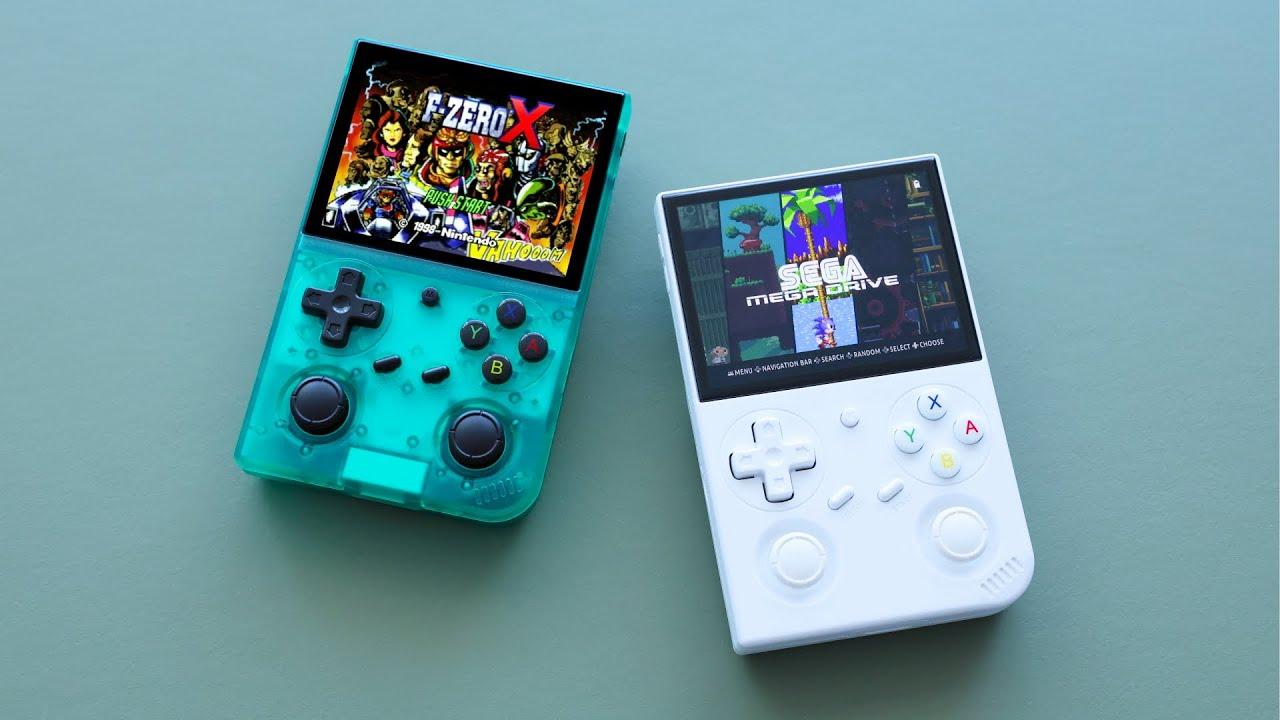
| ANBERNIC RG 34XX | 3.4" IPS, full lamination | 720x480 | 3:2 | Exact 3x integer |
| Anbernic RG34XXSP | 3.4" IPS, full lamination, clamshell | 720x480 | 3:2 | Exact 3x integer |
| TrimUI Brick | 3.2" IPS, full lamination | 1024x768 | 4:3 | Pillarboxed |
| Miyoo Mini Plus | 3.5" IPS | 640x480 | 4:3 | Pillarboxed |
The two 3:2 Anbernics are the natural shape for this library. The 4:3 machines are excellent handhelds that happen to be a worse fit for GBA specifically — pillarboxed output on a 1024x768 panel is still sharp, it just uses less of the glass.
Whichever you pick, sort your saves out before you are a season deep into Baseball Advance — our guide to backing up GBA game saves covers doing it properly.
Frequently asked questions
What is the best sports game on the Game Boy Advance? Tony Hawk's Pro Skater 2, at 95/100. It is not close, and it is not really a licensed sports game so much as an original GBA action game with a skateboard licence attached.
Are there any good football (soccer) games on the GBA? FIFA Football 2005 at 75/100 is the highest-scoring one this list could verify. It is a decent handheld football game rather than a great one — the platform never got a soccer title in the class of the Camelot golf and tennis games.
Why are so many GBA sports games bad? Look at what the three skips have in common: all are annual licensed releases handed to small contract studios and shipped alongside the console versions on the console's schedule. The top four on this list are the opposite — GBA-native designs built for the hardware by studios given room to design something new. MLB SlugFest 20-04 scoring 43 on GBA against 76–78 on consoles is the pattern in a single game.
Can I play these multiplayer on a retro handheld? Usually not. These games use the Game Boy Advance Game Link Cable, and emulation handhelds generally do not implement link play. Two devices plus a netplay-capable frontend, or original hardware, are the options.
Is Mario Golf: Advance Tour worth playing if I do not like golf? Probably, yes. The role-playing structure — a character who levels up, items, four clubs to work through — is doing as much work as the golf, and it is the reason the game scored 84 and earned an IGN Editors' Choice.
Do these need an expensive handheld? No. GBA emulation is comfortably within reach of entry-level devices, and every handheld listed above runs this entire library without trouble. Screen shape is a better thing to spend on than raw power.
Where to go next
For the wider picture of this system's library, our guide to the best GBA games covers the RPGs, platformers and action games that genre lists always crowd out, and the GBA hidden gems list goes further down the shelf. The best GBA racing games is the companion piece to this one, and it has the same problem in reverse — a genre with a handful of excellent games buried under licensed filler.
For the same sport on neighbouring hardware, see the essential SNES sports games and the underrated PlayStation 1 sports games.