Racing is the genre the Game Boy Advance is least famous for and quietly did best. The hardware had no 3D unit at all, so every developer who wanted a road that curved had to fake it, and the two ways they chose to fake it produced two visibly different kinds of racing game on the same cartridge slot.
The first approach borrowed the SNES trick: scale and rotate a flat background layer under the car so the track appears to tilt away toward the horizon. Nintendo's F-Zero games use a Mode 7-style effect built for the GBA to do exactly this. The second approach was to render the track as real texture-mapped polygons and keep the cars as 2D sprites — which is what Eden Studios did on V-Rally 3, where the courses are drawn in real-time textured 3D while the vehicles stay flat.
Knowing which approach a game took tells you most of what it will feel like before you load it. The pseudo-3D racers are fast, readable and forgiving at 240x160. The polygon racers look more impressive in screenshots and generally handle worse.
Below are the ten Game Boy Advance racing games worth your time, ranked, with what each one actually is, how it was received when it shipped, and what the handheld version specifically gives you. After that there is a section on the ones to skip, and a note on the games people search for as GBA racers that were never on the system.
How this list is ranked
Three things decide the order:
- How good it still is to play, not how impressive the engine was in 2002.
- How well it suits a 240x160 screen. A racer that looks stunning in stills and becomes unreadable in motion ranks below a simpler game you can actually drive.
- What the contemporary press made of it. This site has no time machine and no review units, so every judgement below is attributed to the outlet that made it, with a link.
GBA racing games at a glance
| Game | Release | Developer | Style | Critical reception |
|---|---|---|---|---|
| F-Zero: GP Legend | 2003 JP / 2004 NA | Suzak | Futuristic, pseudo-3D | 77/100 |
| Mario Kart: Super Circuit | 2001 | Intelligent Systems | Kart | 93/100 |
| F-Zero: Maximum Velocity | 2001 | NDcube | Futuristic, pseudo-3D | 86/100 |
| Racing Gears Advance | 2004 EU / 2005 NA | Orbital Media | Top-down combat racing | 83/100 |
| Colin McRae Rally 2.0 | 2002 | Codemasters | Rally | Favourable |
| Konami Krazy Racers | 2001 | Konami | Kart | 78/100 |
| GT Advance 3 | 2002 JP / 2003 NA | MTO | Circuit | 74/100 |
| V-Rally 3 | 2002 | Eden Studios | Rally, textured 3D | Mixed |
| F-Zero Climax | 2004, Japan only | Suzak | Futuristic + track editor | Japan-exclusive |
| NFS Carbon: Own the City | 2006 | Pocketeers | Street | IGN 7.0 / GameSpot 6.5 |
The 10 best racing games on Game Boy Advance
1. F-Zero: GP Legend (2004)
The best racing game on the system, and the one most often left off lists of it — probably because it arrived in North America on 20 September 2004, three years into the GBA's life, when the attention had moved on.
Suzak built a new Mode 7-style effect for the GBA that rotates and scales the background layers around your machine, and the result is the cleanest sense of speed on the handheld. What separates it from Maximum Velocity is structure. Alongside Grand Prix across Bronze, Silver, Gold and Platinum cups, it has a Story mode that unlocks each pilot's campaign in turn, plus Time Attack, Training, and a set of Zero Test challenges that function as skill drills. Link-cable multiplayer is supported.
Metacritic's aggregate is 77/100; reviewers praised the Story mode's variety while at least one found its plot impenetrable. GamePro called it "damn fast, damn challenging, and thoroughly addictive." Play it first.
2. Mario Kart: Super Circuit (2001)
The commercial giant of the genre on GBA and still the right pick if you want something to hand to someone else. Intelligent Systems shipped it in North America on 27 August 2001; it went on to sell 5.91 million copies, making it the fourth best-selling Game Boy Advance game, and it holds a Metacritic score of 93/100 — universal acclaim.
The number that matters is 40 tracks. Twenty are new, arranged into five cups; the other twenty are the complete Super Mario Kart circuit from 1992, unlocked a cup at a time by taking a high grade on any of the five original cups. That makes it the only kart game on the platform that is really two kart games.
The multiplayer has a genuinely useful quirk: four players can race from a single cartridge, though single-cart play restricts everyone to Yoshi in different colours and to four tracks from a Super Mario Kart cup. Contemporary reviews were mixed on the multiplayer specifically, and that restriction is why.
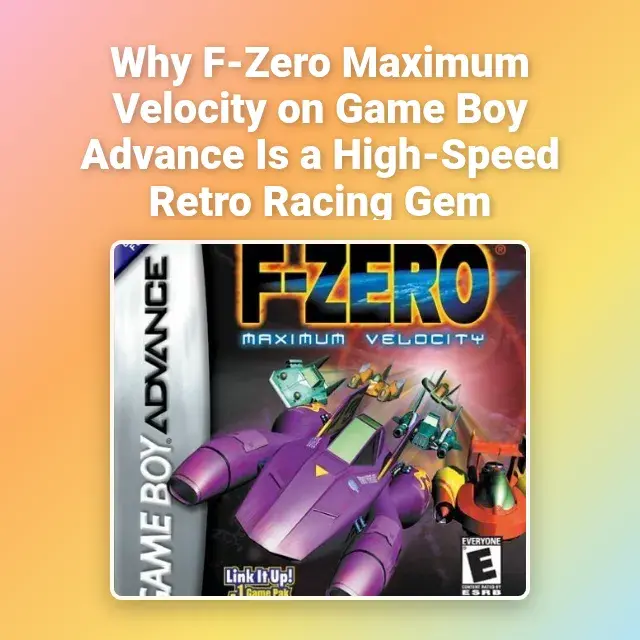
3. F-Zero: Maximum Velocity (2001)
The launch-window F-Zero, developed by NDcube rather than Nintendo EAD, and a considerably better game than its reputation as "the first one" suggests. Metacritic has it at 86/100, with IGN at 9/10 and GameSpot at 8.1/10, and it sold over a million copies.
It is set 25 years after the SNES original and deliberately drops that game's pilots for a new cast, so Captain Falcon is not here. Four Grand Prix series are named after chess pieces — Pawn, Knight, Bishop, Queen — and the difficulty climbs steeply through them. Link-cable play supports two to four players and works from either a single cartridge or multiple ones.
NextGen's contemporary verdict was that it ports the SNES formula well but already looked dated at launch, which is fair. It is also the entry with a dedicated write-up on this site: see why F-Zero Maximum Velocity is a high-speed retro racing gem for the longer version.
4. Racing Gears Advance (2005)
The find. Orbital Media's top-down combat racer reached PAL territories on 17 December 2004 and North America on 8 February 2005 — the tail end of the GBA's commercial life, which is why almost nobody played it. It scored 83/100 on Metacritic across 17 reviews, with Craig Harris at IGN giving it 8.9/10 and Alex Navarro at GameSpot 8.5/10, singling out the controls, the vehicle upgrades and the multiplayer.
It has 25 tracks across five cups named after Greek letters, a proper upgrade economy, and licensed cars from GM, Dodge, Mitsubishi and Lotus, which is unusual for a game that plays from overhead. The soundtrack is by Neil Voss, who scored Tetrisphere and The New Tetris. Harris's one substantive complaint was that it does not save your best lap and race times.
Top-down is the smart choice on a 240x160 screen: nothing is hidden behind a horizon, so the game stays readable at speed in a way the polygon racers do not.
5. Colin McRae Rally 2.0 (2002)
Codemasters brought this to the GBA on 4 October 2002 in Europe and 8 October in North America, and it landed to favourable reviews. It is the rally game on the platform that people who like rally games actually keep.
The handling is the point. Compared with the first Colin McRae, the cars swing their tails less and are easier to place, without becoming arcade-loose, and the manufacturer-licensed vehicles each get their own driving model. The co-driver calls are clear enough to drive on — corner severity and hazards ahead — which on a screen this small is not a nicety but the mechanism that makes the game playable at all. Reviewers repeatedly described it as the best representation of rally racing on a handheld at the time.
The one step backwards from the earlier game is audio: the engine notes lost their rasp in the conversion.
6. Konami Krazy Racers (2001)
A GBA launch title, which makes it the platform's first kart racer, and it is not a Mario Kart clone so much as a parallel evolution — IGN's 8/10 praised how tight and responsive it was without simply copying Nintendo. It aggregates to 78/100 on Metacritic across nine reviews.
The draw is the cast. Konami raided its own back catalogue, so Castlevania, Metal Gear and Gradius characters share a starting grid. Eight racers run per circuit, and items sit at fixed points on the track rather than in randomised boxes, which makes item use a route-planning decision instead of a lottery. It is the kart game to reach for once you want the item game to reward knowing the track.
7. GT Advance 3: Pro Concept Racing (2003)
MTO's circuit racer, published by THQ, released in Japan on 26 April 2002 and North America on 4 February 2003. Metacritic puts it at 74/100, with IGN at 8.5 and GameSpot at 8.1 against noticeably cooler scores elsewhere — GamePro and X-Play both gave it 3/5.
GameSpot's summary, that it is a spicier version of the original GT Advance, is the honest one: this is the third iteration of a competent formula rather than a reinvention. IGN's caveat is worth repeating, because it explains the ranking — it praised the game but noted that Colin McRae Rally 2.0 and Moto Racer Advance had better graphics engines.
Despite the name, the GT Advance series has nothing to do with Sony's Gran Turismo. It is an MTO and THQ series that happens to share two initials.
8. V-Rally 3 (2002)
The technical showpiece, and the clearest demonstration of why technical showpieces are not automatically the best games. Eden Studios and Infogrames rendered every track in real-time texture-mapped 3D, keeping only the cars as 2D sprites — genuinely impressive on hardware with no 3D acceleration whatsoever.
GameSpot's review is blunt about the trade: great eye candy, average gameplay, and it does not drive as well as Colin McRae Rally 2.0 on the same system. That is the ranking in a sentence. Play it to see what the GBA could be pushed to do, then go back to the Codemasters game to actually race.
9. F-Zero Climax (2004)
The awkward, brilliant one. Suzak's third GBA F-Zero shipped only in Japan, on 21 October 2004, and was the last game in the series for nineteen years. It stayed a Japanese exclusive for two decades: an English fan translation appeared in 2021, and Nintendo finally released it internationally through Nintendo Classics on 11 October 2024.
It is worth the detour for one feature. Climax has a track editor. You build courses from track pieces and obstacles up to a budget of 255 points, save them to 30 slots, and share them with other players over the Game Link Cable or as password codes. There are 53 courses in the box on top of that.
Critics who imported it praised the editor and the Survival mode while criticising a short Grand Prix and graphics and music recycled from the earlier games. Both halves of that are true, and the editor is still the reason to load it.
10. Need for Speed Carbon: Own the City (2006)
Included because it is the last Need for Speed on the Game Boy Advance and one of the last notable games on the platform full stop, released 31 October 2006 — five years after Super Circuit.
Two things to get straight. Its full title is Need for Speed Carbon: Own the City, and it is not a port of the console Carbon: the handheld game has a different plot and some exclusive cars. And unlike the PSP version, the GBA and DS versions have no free roam — Pocketeers built an event-driven structure instead. IGN gave the GBA version 7.0 and GameSpot 6.5, the lowest scores of the three launch platforms.
It is a competent street racer with car customisation and a career structure, and it is the only game on this list built for the licensed-tuner-culture itch. Just do not expect the console game in miniature.
The ones to skip
ATV: Quad Power Racing (2002). Tantalus's off-road racer arrived in North America on 28 August 2002 and holds a Metacritic score of 49/100 — IGN 5.5, GameSpot 5. IGN's criticism was specific and damning: the engine is impressive, and the design around it has very little challenge or variety. It appears on a lot of GBA racing lists, including an earlier version of this one, and it should not.
Hot Wheels: Stunt Track Challenge (2004). Razorback Developments' GBA conversion of the Climax Brighton console game shipped in November 2004 to mixed reviews. It is not offensive, but with Racing Gears Advance three months away and Super Circuit already on the shelf, there is no argument for it.
Games people look for on GBA that were never there
This list gets rewritten periodically because racing round-ups attract the same handful of confident errors. Three worth naming:
- Need for Speed: Carbon. The 2006 console game was never on Game Boy Advance. The GBA release is Carbon: Own the City, a separate handheld game by a different studio, described above.
- Gran Turismo. No Polyphony Digital game has ever appeared on a Nintendo handheld. If you have seen "GT" on a GBA cartridge, it was MTO's GT Advance series.
- Diddy Kong Racing. An N64 game from 1997, later remade for the Nintendo DS. It has never been on the Game Boy Advance, and it is not a SNES game either, despite turning up on lists of both.
Playing GBA racers on a modern handheld
GBA emulation is trivial for anything sold today — the bottleneck is not the processor, it is the screen and the D-pad. Two specifics matter more for racing than for any other genre.
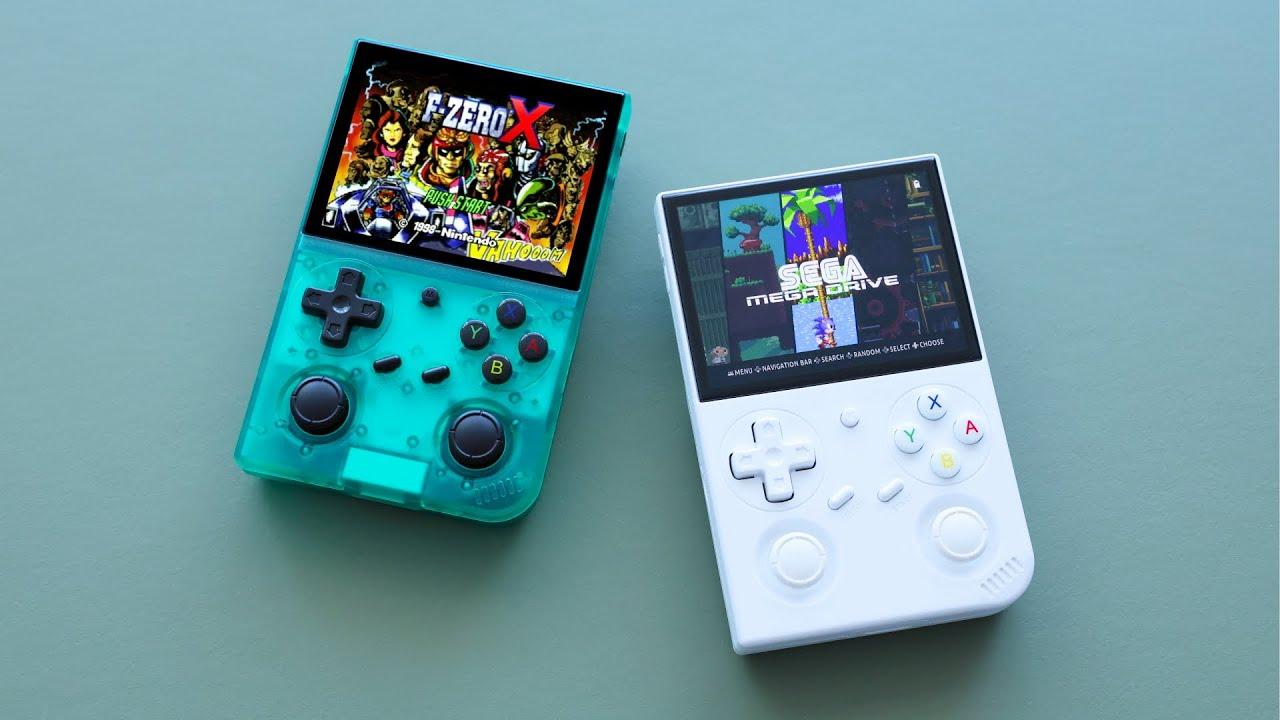
Aspect ratio. The GBA renders at 240x160, which is 3:2. A 4:3 screen has to pillarbox that or stretch it, and stretching a pseudo-3D horizon is exactly where the distortion shows. A 720x480 panel is 3:2 and gives GBA output a clean 3x integer scale with no interpolation at all — every source pixel becomes a 3x3 block. That is the single biggest visual difference between handhelds for this library.
The D-pad. Every game above steers on the d-pad, and F-Zero and Colin McRae both ask for held partial inputs on the diagonals. A mushy pad is more disqualifying here than in a platformer.
All specifications below were read from the retailers' own product listings on 5 September 2026.
| Handheld | Screen | Resolution | Aspect | GBA scaling |
|---|---|---|---|---|
| ANBERNIC RG 34XX | 3.4" IPS, full lamination | 720x480 | 3:2 | Exact 3x integer |
| Anbernic RG34XXSP | 3.4" IPS, full lamination, clamshell | 720x480 | 3:2 | Exact 3x integer |
| TrimUI Brick | 3.2" IPS, full lamination | 1024x768 | 4:3 | Pillarboxed |
| Miyoo Mini Plus | 3.5" IPS | 640x480 | 4:3 | Pillarboxed |
The two 3:2 Anbernics are the ones built for this library — the SP is the same panel in a clamshell with a hall-sensor sleep hinge if you want the flip form factor. The 4:3 machines are excellent handhelds that happen to be a worse shape for GBA specifically: pillarboxed GBA on a 1024x768 panel is still sharp, it just uses less of the glass.
Frequently asked questions
What is the best racing game on the Game Boy Advance? F-Zero: GP Legend for single-player, Mario Kart: Super Circuit if you want to race someone next to you. Super Circuit has the higher aggregate score of the two (93 against 77), but it is carrying twenty tracks of 1992 Super Mario Kart to get there.
Are there any 3D racing games on the GBA? Yes, in the strict sense. V-Rally 3 renders its tracks as real-time texture-mapped polygons, with 2D sprites for the cars. The F-Zero games and the kart racers instead use a Mode 7-style scaled-and-rotated background, which looks three-dimensional without being so.
Can you play GBA racing games multiplayer? On original hardware, yes, over the Game Link Cable. Mario Kart: Super Circuit supports four players and will even run four players from one cartridge, at the cost of restricting everyone to Yoshi and four Super Mario Kart tracks. F-Zero: Maximum Velocity supports two to four players from single or multiple cartridges. On emulation handhelds, link play generally is not available — it needs either a device with link emulation or two machines and a netplay-capable frontend.
Is F-Zero Climax worth importing? You no longer have to. It was Japan-only from 2004 until Nintendo released it internationally through Nintendo Classics on 11 October 2024, and an English fan translation had existed since 2021. The track editor is the reason to play it.
Which GBA racing game has the most content? Mario Kart: Super Circuit, on raw track count — 40, of which 20 are the complete Super Mario Kart line-up. F-Zero Climax technically exceeds it with 53 courses plus unlimited player-built ones, but only if you count a track editor as content.
Where to go next
If you want the wider picture of what this handheld's library holds, our guide to the best GBA games covers the RPGs, platformers and action games that racing lists always crowd out. The best GBA sports games is the companion guide for the other genre this system is unfairly written off for. For the generation either side of it, the most addictive SNES racing games covers where the Mode 7 racer was invented, and the N64 racing games list covers where it went once real polygons arrived.