Anbernic RG DS: Specs, Price, and RG DS vs RG DS Plus vs RG DDS
The Anbernic RG DS is a $94.99 dual-screen DS-style handheld with Android 14. Specs, what reviewers found, and how it compares with the RG DS Plus and RG DDS.
 reviews
The Anbernic RG DS is a $94.99 clamshell handheld built to play Nintendo DS games on two real screens: two 4-inch 640x480 touchscreens, a Rockchip RK3568 chip and Android 14, at Anbernic's own store on 29 October 2026. Reviewers agree it plays DS games well and is too slow for much else. If you want 3DS, the $284.99 Anbernic RG DDS is the model for it; if you only want DS, the same-price Anbernic RG DS Plus has sharper screens that scale DS games evenly.
This page sets out the specs from Anbernic's listing, what the outlets that tested it found, and how the three Anbernic dual-screen models compare. We have not tested the RG DS ourselves; every hands-on finding below is credited to the outlet that made it.
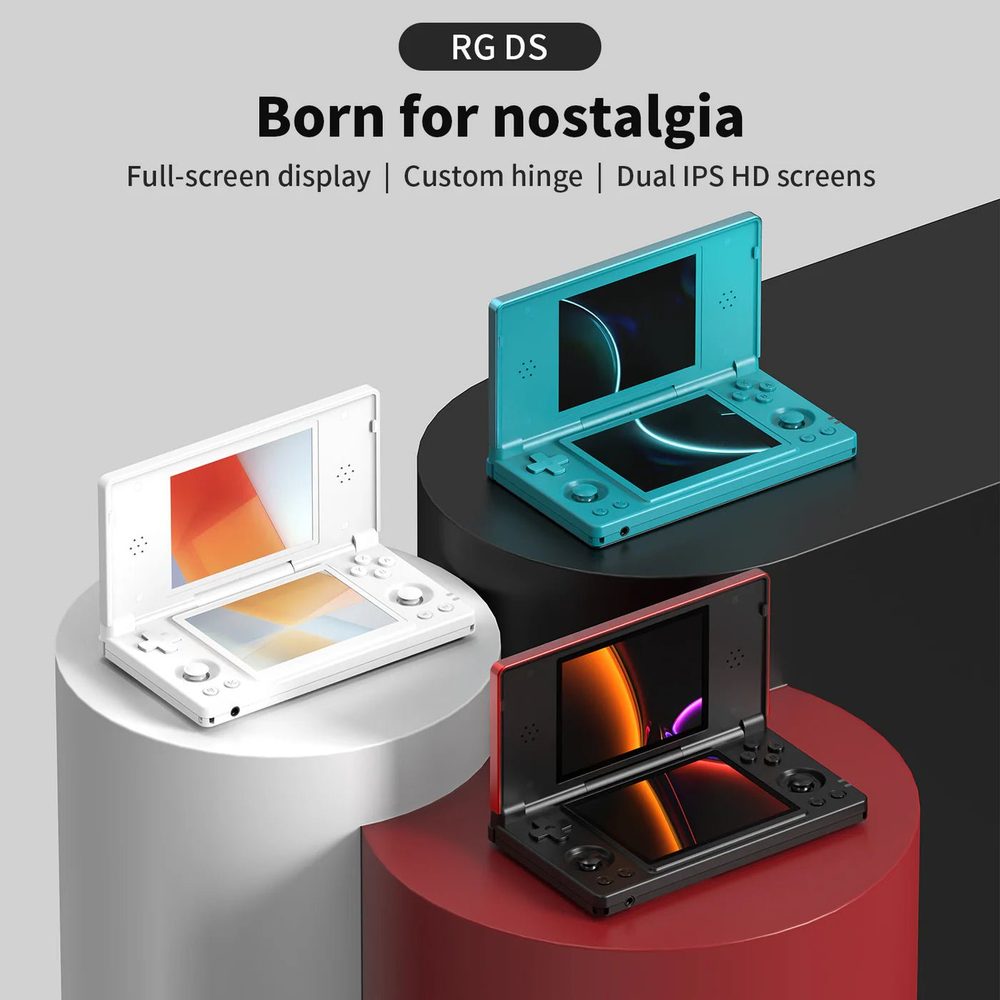
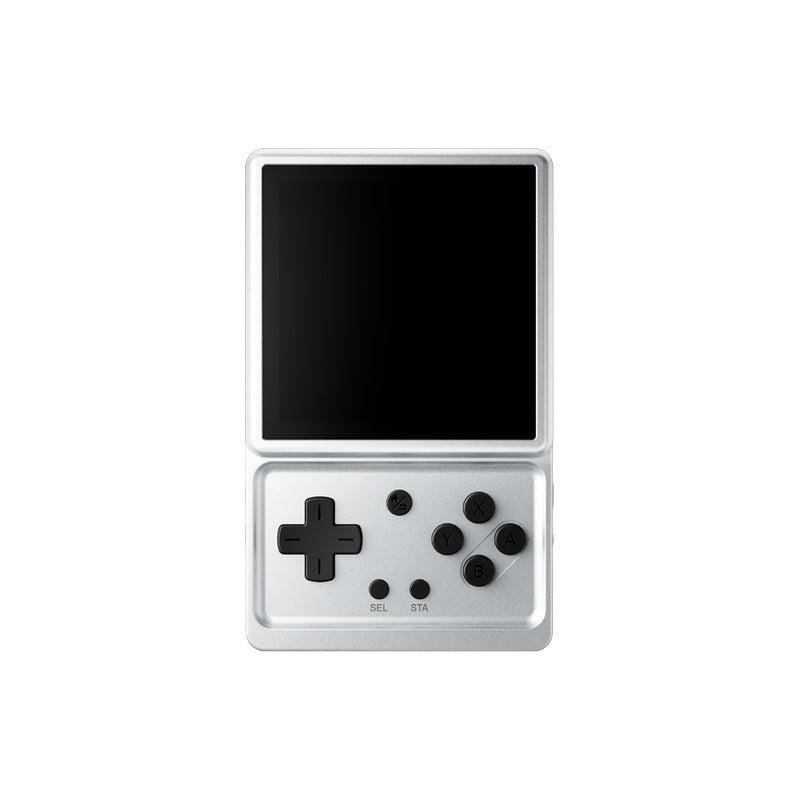
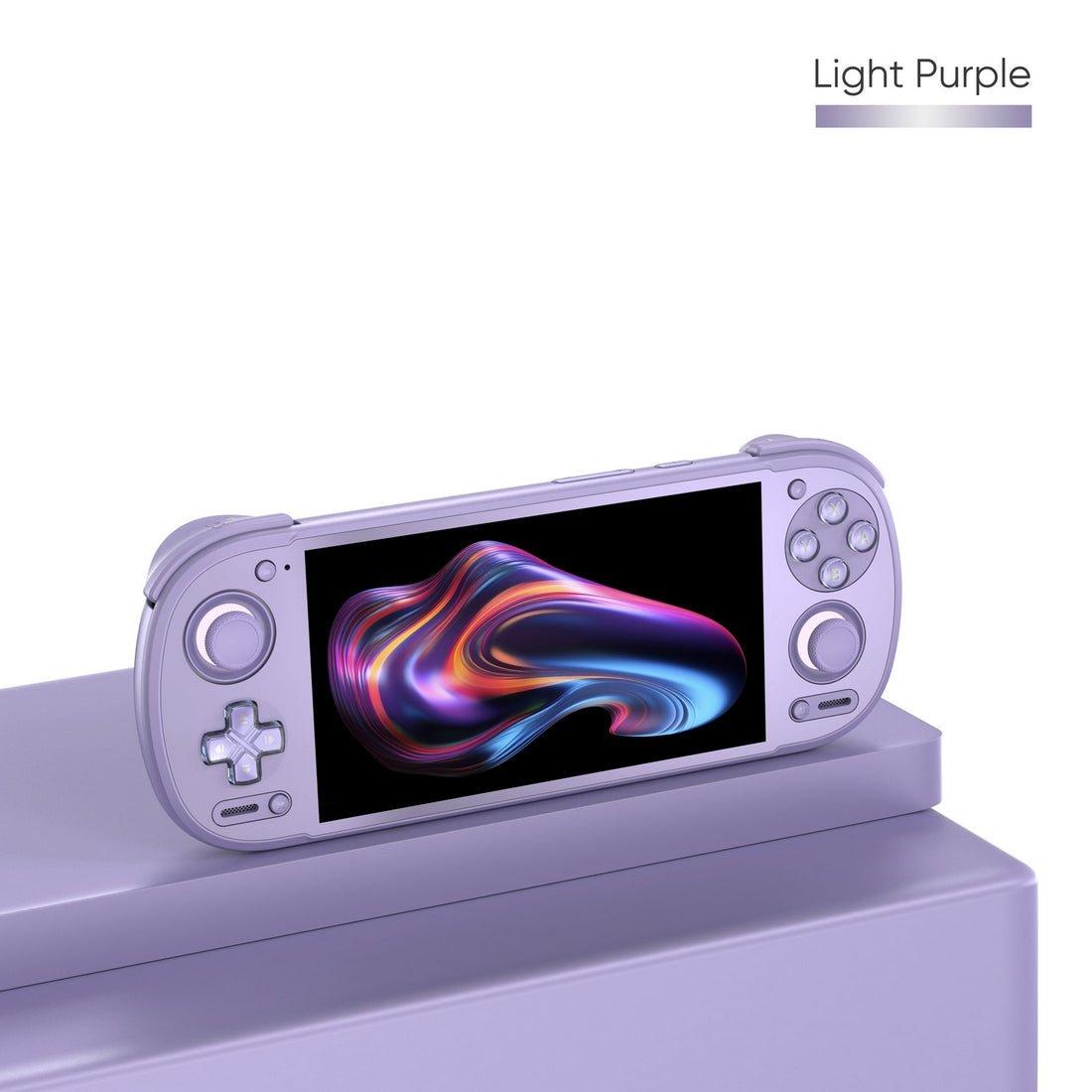
The three RG DS colours. Image: Anbernic, from the RG DS product listing at LitNXT.
What the RG DS is
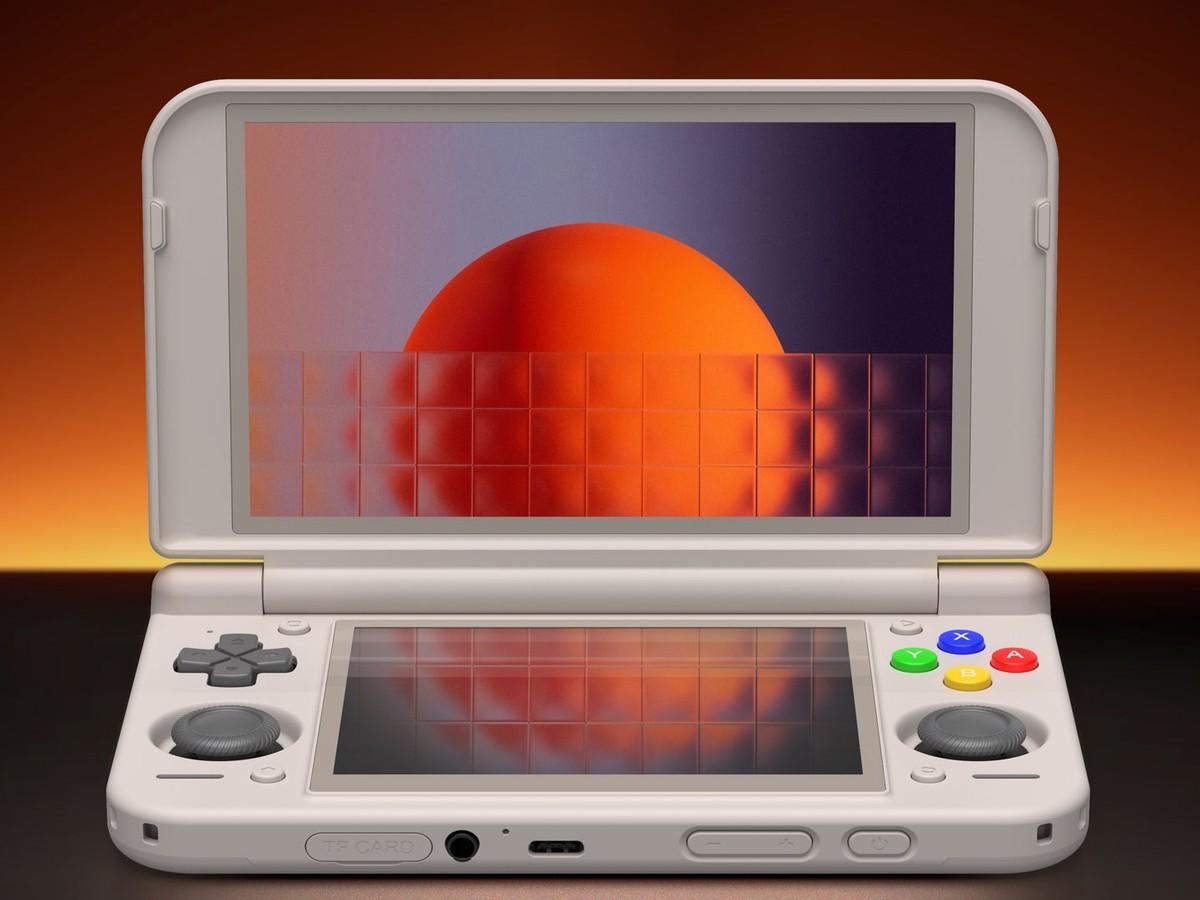
Anbernic released the RG DS in late 2025. It is shaped like a Nintendo DSi: two screens of the same size joined by a hinge, a D-pad and four face buttons, and a capacitive stylus in the box. Anbernic added two small analog sticks, a Hall sensor that sleeps the console when you close the lid, a six-axis gyroscope and a vibration motor.
The chip is the Rockchip RK3568, a quad-core Cortex-A55 at up to 2.0GHz with an ARM Mali-G52 2EE GPU. That is a low-power part. It is fast enough for DS emulation in DraStic, and that is the job the RG DS was built for.
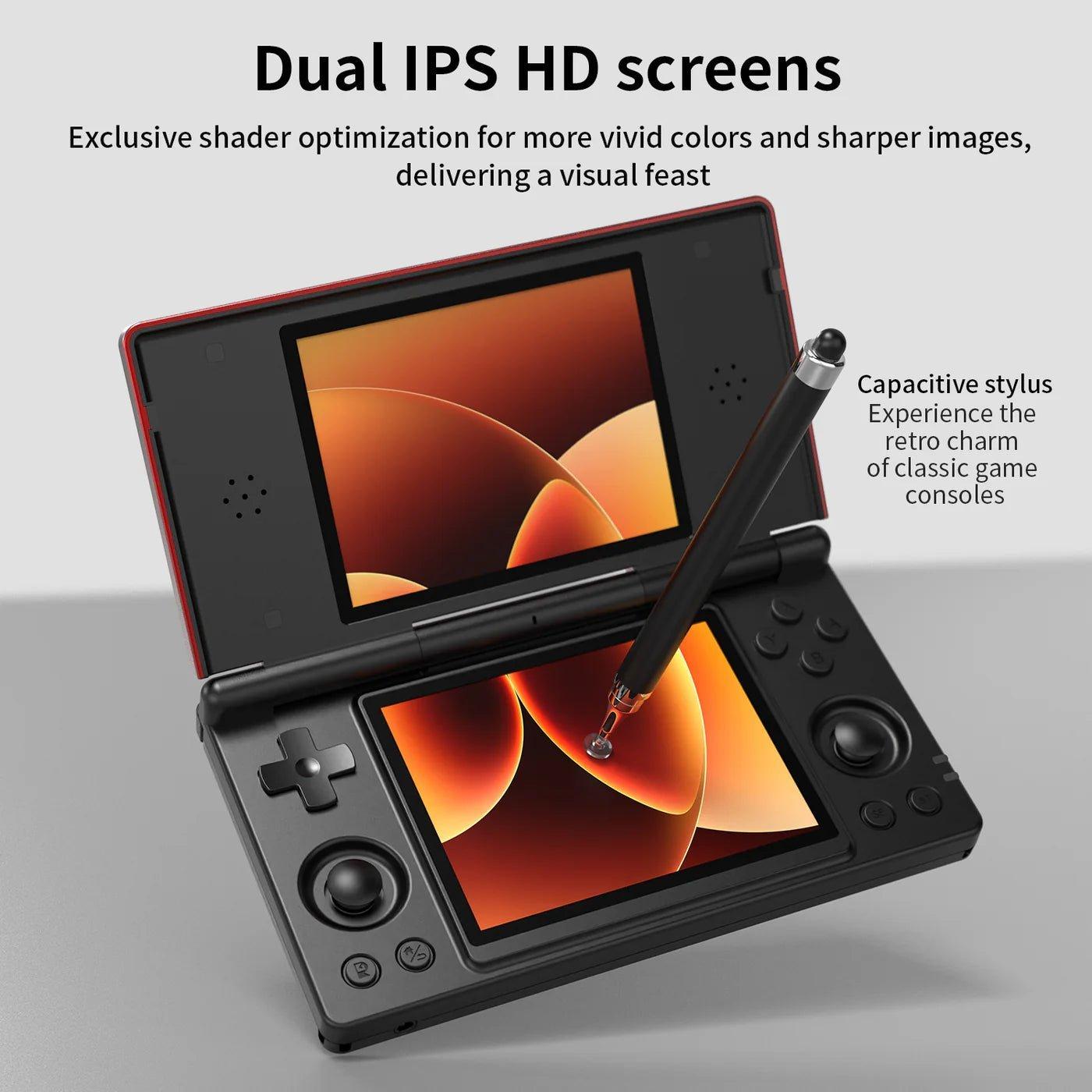
Both screens take touch input, and Anbernic lists both as supporting its capacitive stylus. That matters when you compare it with the RG DS Plus, which only has touch on the bottom screen. Original DS styluses will not work, because the panels are capacitive rather than resistive, as Android Authority pointed out.
Anbernic RG DS specs
From Anbernic's product listing, checked on 29 October 2026:
| Spec | Anbernic RG DS |
|---|---|
| Screens | Two 4-inch IPS, 640x480, OCA laminated, multi-touch on both, capacitive stylus support |
| Chip | Rockchip RK3568, quad-core Cortex-A55 up to 2.0GHz |
| GPU | ARM Mali-G52 2EE |
| RAM and storage | 3GB + 32GB, microSD up to 2TB |
| System | Android 14 (Linux also listed) |
| Wireless | Wi-Fi 802.11a/b/g/n/ac (2.4 and 5GHz), Bluetooth 4.2 |
| Battery | 4,000mAh, rated "6 hours" by Anbernic |
| Charging | 5V/1.6A, about 3.5 hours to full by Anbernic's figure |
| Other | Hall sleep switch, six-axis gyroscope, vibration motor, stereo speakers, 3.5mm headphone jack, screen casting |
| Size and weight | 160 x 91 x 21.5mm, 321g |
| In the box | USB-C cable, capacitive stylus, screen protector, lanyard, manual |
| Colours | Black and Crimson Red, Turquoise Blue, Polar White |
The 640x480 screens are 4:3, the same shape as a DS screen, but 480 divided by 192 (the DS's vertical resolution) is 2.5. DS games therefore scale by a fraction. Anbernic turns a shader on by default to hide the uneven pixels, and Android Authority found it does that job.
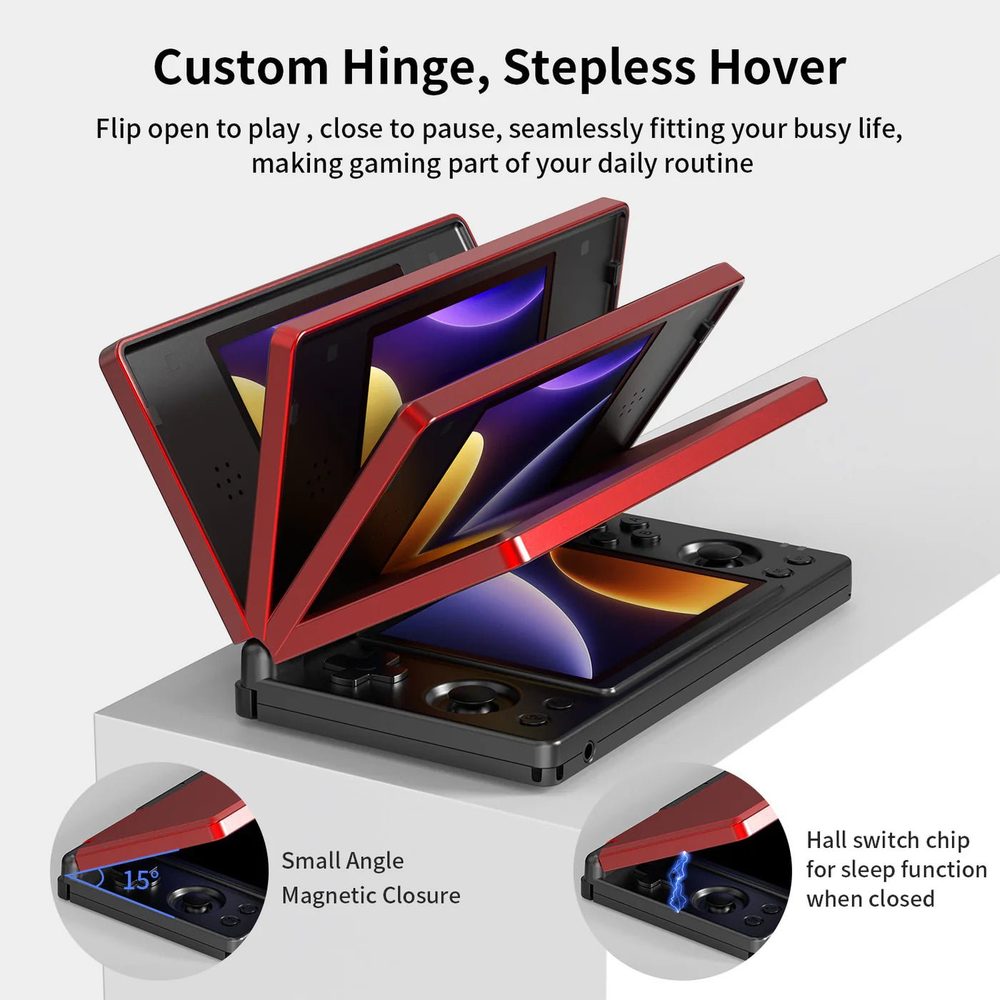
Anbernic's hinge graphic: the lid holds at any angle and a Hall switch sleeps the console when closed. Image: Anbernic, via LitNXT.
What reviewers found
Three outlets on this site's sources list tested the RG DS. They agree on DS games and disagree on how much the flaws matter.
| Outlet | Reviewer and date | DS games | Battery | Verdict in brief |
|---|---|---|---|---|
| Android Authority | Nick Fernandez, 14 December 2025 | Everything tested ran well in DraStic, up to 2x upscaling; melonDS too slow | About 4 to 5 hours, both screens on | Recommended for DS fans |
| Retro Handhelds | Jim Gray, 25 November 2025 (updated 13 February 2026) | Upscaled DS ran well in DraStic, but the top screen froze at times | Too early to judge | Promising but unreliable on its unit; hoped custom firmware would help |
| Retro Game Corps (video, as summarised by Notebookcheck, 10 December 2025) | Russ | Good for DS; touch lag in some games | About 4 hours, about 3 hours to charge | Worth a look on a tight budget, not an unqualified buy |
Android Authority was the most positive. Nick Fernandez wrote that the RG DS "feels more like a Nintendo DS than any other modern handheld" and praised the D-pad, the face buttons and a hinge stiff enough to hold any angle. He found the shoulder buttons loud and the small inset sticks slippery. In DraStic every game he tried ran at full speed. melonDS, the more accurate open-source emulator, ran nothing he tested at full speed. Systems up to PS1 were fine, and you can switch off the top screen to save battery when playing them. Most 3DS games were out of reach; Rune Factory 4 was an exception. His complaints were touch lag (bad news for rhythm games), slow charging at about 2.5 hours, and no charge-limit setting.
Retro Handhelds was harder on it. Jim Gray found the screens sharp and DraStic's upscaled output good, with mild warmth during long sessions. But the top screen froze at random on his unit, swapping layouts in DraStic only changed the bottom screen, and the D-pad registered false diagonals. He also found the shell large and uncomfortable over long sessions. His conclusion was that it is "not great at the one thing it exists to do", and that community firmware such as GammaOS may fix the software side.
Retro Game Corps landed between the two. Notebookcheck's summary of the video says the RK3568 cannot handle real multitasking across the two screens (playing a video on one screen while emulating on the other costs performance), that the range of systems it emulates well is narrow, and that touch input lags in some games. Notebookcheck adds that software updates could improve things.
The pattern across all three: DS games in DraStic are good, the chip has no headroom past that, and battery life in real use is four to five hours against Anbernic's six.
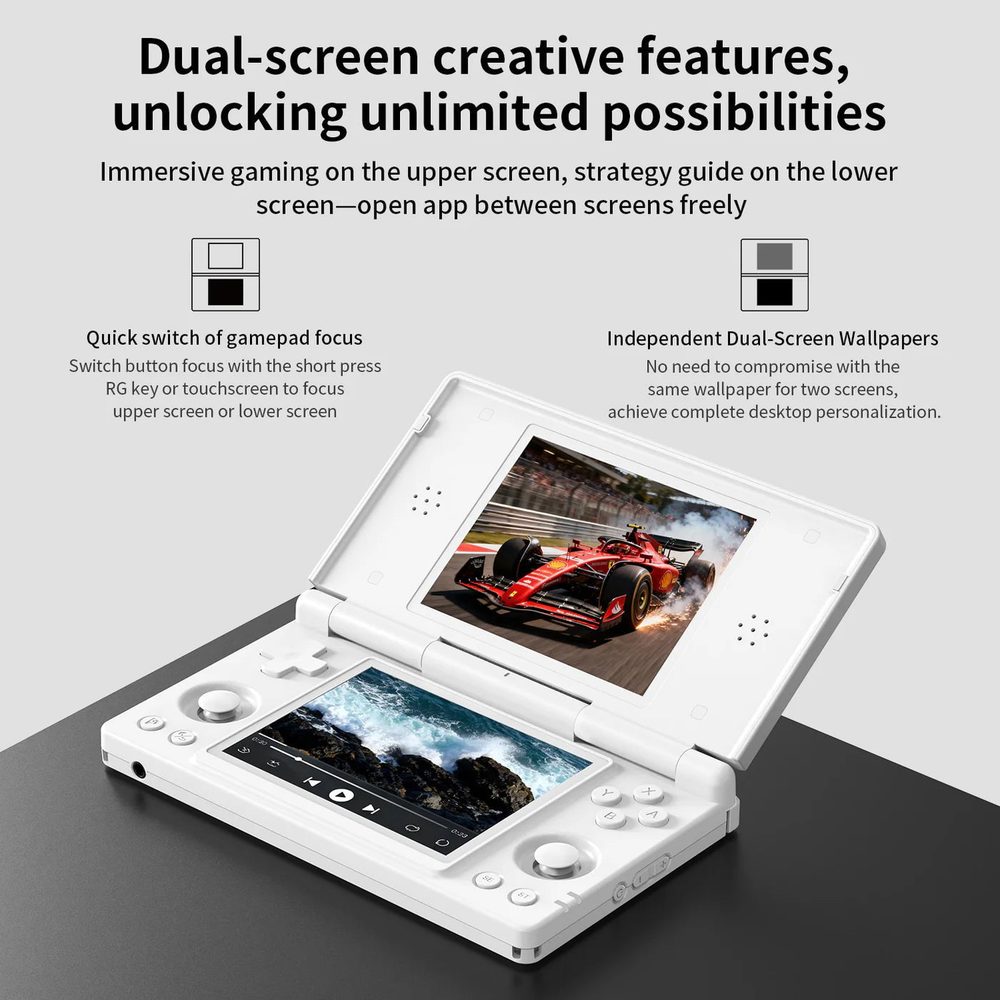
Anbernic's split-screen mode runs one app per screen. Retro Game Corps found the RK3568 slows down when both are busy. Image: Anbernic, via LitNXT.
Android, Linux and frontends
The RG DS boots Android 14 from its 32GB of internal storage. That means Android emulators such as DraStic and RetroArch install as ordinary apps, and Android frontends built for two screens run on it. Cocoon 3, the free launcher Retro Game Corps picks for dual-screen devices, names the RG DS in its 3.1 release notes as a target for smoother menus on slower hardware.
Anbernic also lists Linux. It sells the console with a 64GB Linux card for $109.99, and LitNXT sells Android and Linux card bundles. Retro Handhelds pointed to GammaOS, a community firmware, as a possible fix for the screen problems it hit; we have not confirmed which community firmwares support the RG DS today, so check each project's device list before you buy for one.
RG DS vs RG DS Plus vs RG DDS
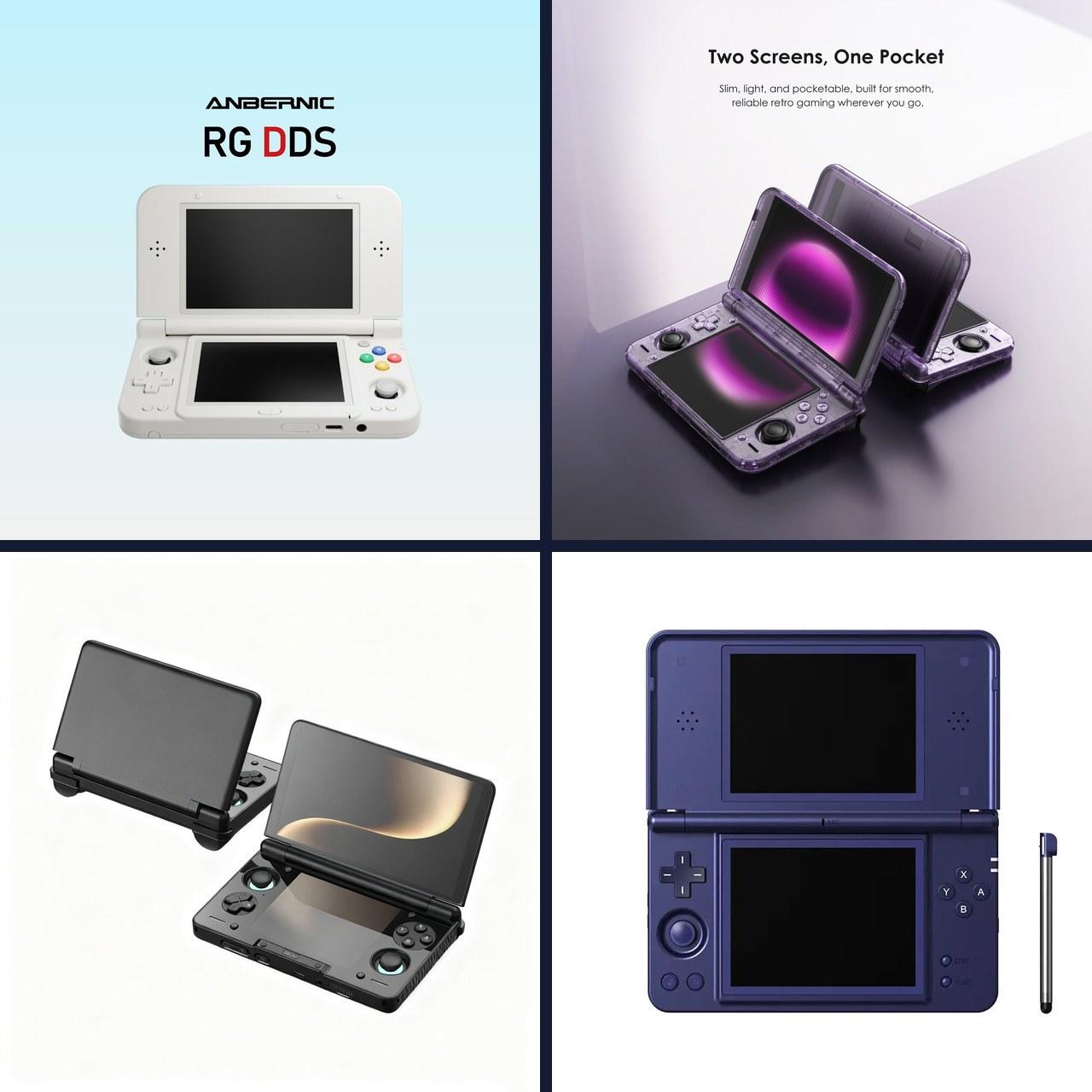
Anbernic now sells three dual-screen handhelds. The RG DS and RG DS Plus cost the same and target DS games; the RG DDS is a much faster 3DS-shaped machine at three times the price. Specs and prices from each product's listing on anbernic.com, 29 October 2026:
| Anbernic RG DS | Anbernic RG DS Plus | Anbernic RG DDS | |
|---|---|---|---|
| Price at Anbernic | $94.99 (list $99.99) | $94.99 | $284.99 for 8GB/128GB, $349.99 for 12GB/256GB (pre-order) |
| Top screen | 4" 640x480 IPS, touch | 4.3" 1024x768 IPS, no touch | 4.7" 1200x720 IPS, 5:3 |
| Bottom screen | 4" 640x480 IPS, touch | 4.3" 1024x768 IPS, touch | 4" 960x720 IPS, 4:3 |
| DS scaling | 2.5x (uneven) | 4x (even) | 3.75x (uneven) |
| Chip | Rockchip RK3568 | Rockchip RK3568 | Snapdragon G2 Gen 2 |
| RAM and storage | 3GB + 32GB | 1GB, 16GB card | 8GB + 128GB or 12GB + 256GB |
| System | Android 14 (Linux listed) | Linux | Android 16 |
| Battery | 4,000mAh | 4,000mAh | 6,000mAh, 27W charging |
| Weight | 321g | 344g | 434g |
| Stock on 29 Oct | China: in stock. US: console only out of stock, 64GB Linux bundle in stock | In stock from China, US and EU | Pre-order from China; US variants unavailable |
RG DS or RG DS Plus. For DS games alone, the RG DS Plus has the better screens. 1024x768 is exactly four times the DS resolution in each direction, so games scale cleanly without a shader. Retro Handhelds' Ban, reviewing the Plus on 28 September 2026, called it a "perfect DS alternative" that feels much better in the hand than the original, while regretting the lack of internal storage and the drop to one analog stick. His pink review unit died during testing, which is worth knowing. Pick the RG DS instead if you want Android: the Plus has 1GB of RAM and runs Linux, so Android apps, the Play Store and Android frontends are out. The RG DS also keeps touch on both screens.
RG DS or RG DDS. The RG DDS is a different class of device. Its Snapdragon G2 Gen 2 is aimed at 3DS, and Anbernic sized its screens at exactly three times the 3DS resolution. It is a pre-order shipping from 10 December, and no outlet had published a full review by the time we checked. Our RG DDS explainer has its specs and launch details. If you only play DS and older games, the RG DS does that for a third of the price. If 3DS is the reason you want two screens, skip the RG DS.
For the wider field, including the Retroid Pocket Duo and the AYN Thor, see our dual-screen handhelds comparison.
Where to buy the RG DS
Prices from each store's product data on 29 October 2026. Anbernic's own store was cheaper than LitNXT by $65 for the console alone.
| Store | Console only | With card | Stock and shipping |
|---|---|---|---|
| Anbernic RG DS | $94.99 | $109.99 with a 64GB Linux card | All colours in stock from the China warehouse. US warehouse: console-only out of stock, 64GB bundle in stock |
| Anbernic RG DS from LitNXT | $159.99 | $179.99 (64GB Linux card), $185.99 (128GB Android card), $215.99 (256GB Android card) | All colours in stock |
LitNXT also lists the 64GB Linux card alone for $39.99. That is the card, not the console.
Most of this site's readers are outside the US. Anbernic lists China-warehouse variants of every colour at $94.99 console-only, and those are the ones a UK, EU, Canadian or Australian buyer would compare; check the shipping cost to your country at checkout. US buyers who want delivery from the US warehouse were limited to the $109.99 bundle on 29 October.
Who the RG DS suits
- Buy it if you want Nintendo DS games on two real screens under $100, you want Android rather than Linux, and you can live with four to five hours of battery.
- Buy the RG DS Plus instead if DS is all you play and you would rather have sharper screens that scale DS games evenly. It costs the same.
- Buy the RG DDS instead if you want 3DS and can wait for a December ship date and the first full reviews.
- Skip all three if you have never wanted two screens. A single-screen handheld does everything else better for the money; our Anbernic guide covers the range.
If you are deciding what to play once it arrives, our list of the best DS games covers the 20 to start with and what each one does with two screens.
Frequently asked questions
- How much does the Anbernic RG DS cost?
- On 29 October 2026 the Anbernic RG DS was $94.99 for the console alone at Anbernic's own store, down from a $99.99 list price, or $109.99 with a 64GB Linux card. LitNXT sold the console alone for $159.99. At Anbernic, the console-only version was in stock from the China warehouse but out of stock from the US warehouse, where only the $109.99 bundle could be ordered.
- Is the Anbernic RG DS worth it?
- For Nintendo DS games, most reviewers say yes at $94.99. Android Authority called it its favourite way to revisit DS games, and every game it tested ran well in DraStic. For anything beyond DS and PS1-era systems it is a weak buy: the Rockchip RK3568 is a low-power chip, battery life in testing was around four to five hours, and Retro Handhelds hit screen freezes on its unit.
- Can the Anbernic RG DS play 3DS games?
- Mostly no. Android Authority found most 3DS games out of reach on the RK3568, with Rune Factory 4 one of the few exceptions. If 3DS is the reason you want two screens, the Anbernic RG DDS (a $284.99 pre-order on a Snapdragon G2 Gen 2, with screens sized at three times 3DS resolution) is the Anbernic built for it.
- What is the difference between the Anbernic RG DS and RG DS Plus?
- Both use the Rockchip RK3568 and both cost $94.99 at Anbernic. The RG DS has two 4-inch 640x480 touchscreens, 3GB of RAM, 32GB of storage and Android 14. The RG DS Plus has two larger 4.3-inch 1024x768 screens with touch on the bottom one only, 1GB of RAM, no internal storage and Linux on a 16GB card. The Plus screens scale DS games by exactly four times; the RG DS screens do not scale evenly.
- Does the Anbernic RG DS run Linux or Android?
- It ships with Android 14 on 32GB of internal storage. Anbernic also lists Linux as a system, and sells the console with a 64GB Linux card for $109.99; LitNXT sells Android and Linux card bundles as well. Retro Handhelds suggested GammaOS, a community firmware, might fix some of the software problems it found.
 games